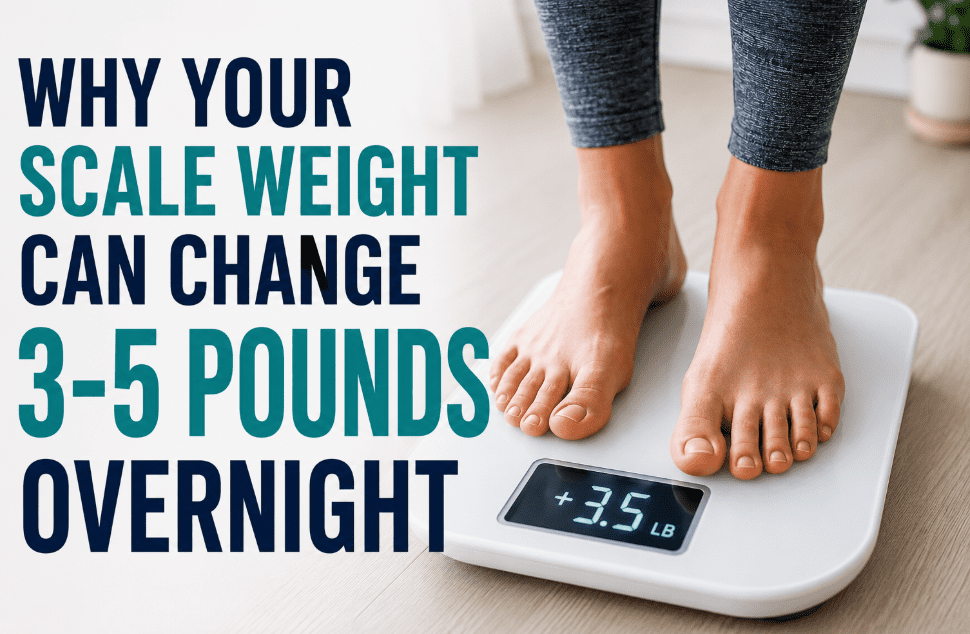
You step on the scale one morning and suddenly you’re 3, 4, or even 5 pounds heavier than yesterday. It can be frustrating—especially when you’ve been following your weight-loss plan.
The good news? A sudden overnight increase on the scale usually does not mean you gained several pounds of body fat.
Your weight can fluctuate 3–5 pounds overnight from water retention, sodium, carbohydrates, digestion, hormones, and bowel movements—not necessarily body fat.
Why Does Your Weight Change So Much Overnight?
Body weight isn't just body fat. The number you see on the scale includes water, muscle, fat, food and fluids in your digestive system, and waste.
Because these factors change from day to day, your scale can change even when your body fat has not.
Here are some of the most common reasons.
1. You Ate More Sodium Than Usual
Did you have restaurant food, takeout, deli meat, soup, sauces, or another salty meal yesterday?
Your body may temporarily hold additional water after a high-sodium meal. That extra water can cause the scale to jump the following morning.
This is one reason you may see a higher number after eating out—even when you didn't dramatically exceed your normal calorie intake.
2. You Ate More Carbohydrates
Carbohydrates are stored in the body as glycogen, primarily in your muscles and liver. Glycogen is stored along with water.
If you've been eating relatively few carbohydrates and suddenly have pizza, pasta, bread, dessert, or another carbohydrate-heavy meal, your body may temporarily store more glycogen and water.
The result? The scale goes up—but that doesn't necessarily mean you've gained that amount in fat.
3. There's Still Food in Your Digestive System
Everything you eat and drink has physical weight.
A larger dinner, a late-night meal, increased fluid intake, or simply having more food moving through your digestive tract can affect your morning weight.
Until that food has been fully digested and waste eliminated, some of its weight is reflected on the scale.
4. You Haven't Had a Bowel Movement
Constipation can have a noticeable impact on scale weight.
If your bowel movements have become less frequent, the scale may remain elevated even though you are still making progress with your weight-loss program.
This can be particularly relevant for people taking GLP-1 medications, since gastrointestinal changes such as constipation can occur.
5. Hormonal Changes Can Cause Water Retention
Hormonal fluctuations can significantly affect fluid retention, particularly in women.
Changes surrounding the menstrual cycle, perimenopause, and menopause may cause temporary bloating and changes in scale weight.
This is why comparing your weight over time is often more informative than focusing on one isolated reading.
6. A Hard Workout Can Temporarily Increase Your Weight
Exercise is good for your health and weight-management goals, but a challenging workout can sometimes make the scale temporarily move up.
When muscles are challenged, the body's normal recovery process can involve temporary fluid shifts. This is especially common when starting a new exercise program or increasing workout intensity.
Don't assume a higher number the morning after a difficult workout means your workout "didn't work."
7. You Didn't Drink Enough Water
It sounds contradictory, but changes in hydration can affect the number on the scale in either direction.
Hydration status varies throughout the day based on fluid intake, sodium intake, exercise, sweating, medications, alcohol, and other factors.
That's another reason a single weigh-in doesn't tell the whole story.
Did You Really Gain 5 Pounds of Fat Overnight?
Usually, no.
Rapid changes from one morning to the next are much more likely to reflect changes in water, digestion, glycogen, and other normal fluctuations than an equivalent change in body fat.
Instead of reacting to one measurement, look at the overall trend across several weeks.
How to Get More Consistent Weight Measurements
For better comparisons, try weighing yourself under similar conditions each time:
- Weigh yourself at approximately the same time.
- Morning is often the easiest time to stay consistent.
- Use the bathroom before weighing.
- Weigh before eating or drinking.
- Wear similar clothing—or no clothing.
- Use the same scale on the same hard, level surface.
- Pay attention to your overall trend rather than one day's number.
The Scale Isn't Your Only Measure of Progress
Successful weight management involves more than watching pounds disappear.
Depending on your individual goals, progress may also include changes in body composition, waist circumference, clothing fit, strength, energy, eating habits, and overall health markers.
This is especially important during medical weight loss. Losing body fat while preserving lean muscle mass can be more meaningful than simply trying to make the scale drop as quickly as possible.
Don't Let One Morning on the Scale Ruin Your Week
Seeing the scale jump overnight can be discouraging, but don't immediately assume you've undone your progress.
Ask yourself:
Did I eat a salty meal? Did I eat more carbohydrates? Am I constipated? Did I work out harder than usual? Am I experiencing hormonal changes?
Sometimes the explanation is much simpler than it appears.
One weigh-in is a snapshot. Your long-term trend tells the bigger story.
Ready to take the next step? Call Envizion Medical today at 813-279-2211 to learn more about our medical weight-loss programs and schedule your consultation.
Author
 Moriah Muriello
Moriah is a weight loss coach currently in nursing school, driven by a genuine passion for helping people transform their health. Blending her growing clinical knowledge with real-world coaching experience, she supports patients with a balance of expertise, motivation, and compassion. Her approach is personal and empowering—meeting each individual where they are and guiding them toward sustainable weight loss and overall wellness. With a strong passion for fitness and healthy living, her commitment shines through in everything she does, from one-on-one coaching to sharing thoughtful, educational insights through her writing.