FDA Safety Update – February 9, 2026
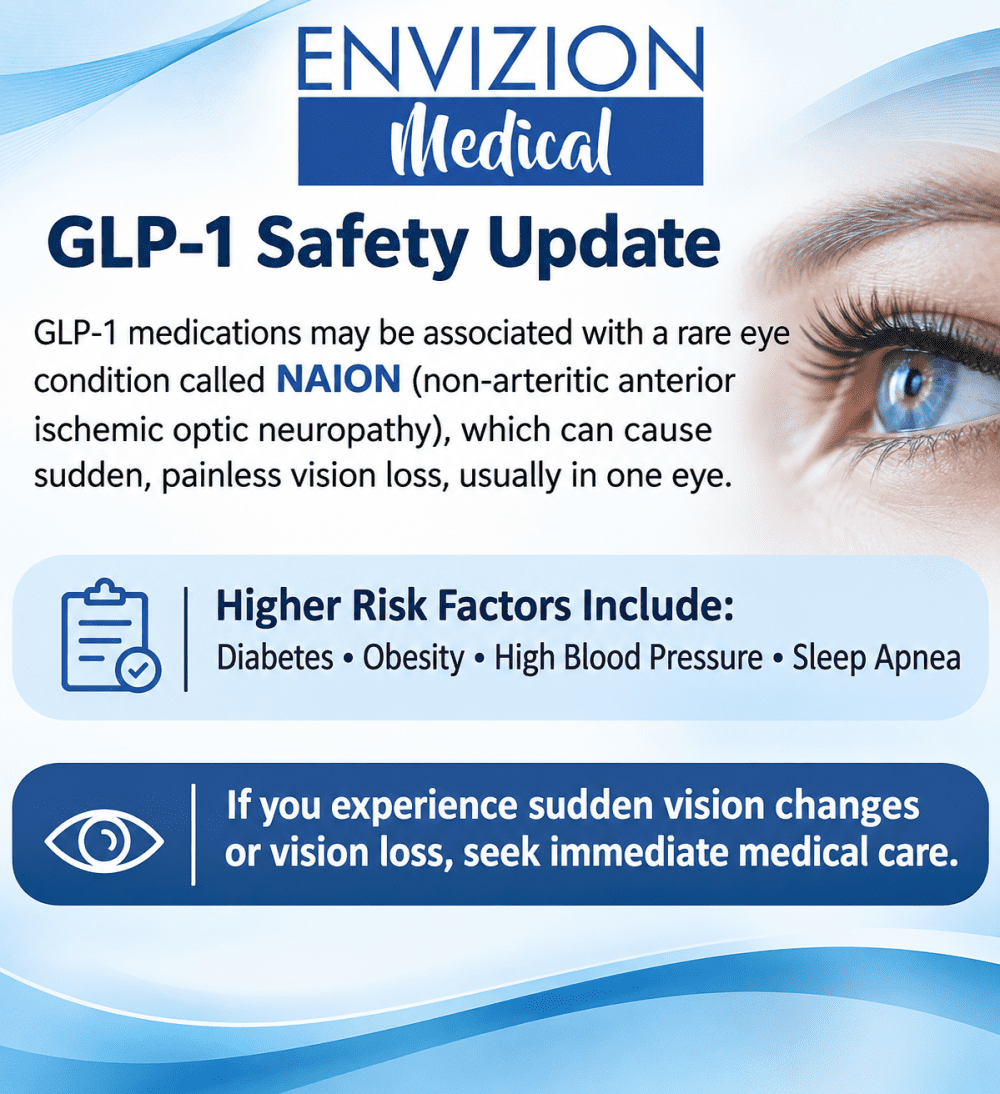
The U.S. Food and Drug Administration (FDA) has addressed a potential safety concern involving glucagon-like peptide-1 (GLP-1) receptor agonists and a rare eye condition known as non-arteritic anterior ischemic optic neuropathy (NAION).
NAION is a condition caused by reduced blood flow to the optic nerve, resulting in sudden, typically painless vision loss, most commonly affecting one eye. Symptoms are frequently noticed upon awakening.
Understanding the Risk Factors
Several underlying medical conditions are associated with an increased risk of developing NAION, including:
Clinical studies have identified an association between certain GLP-1 medications and NAION. However, an observed association does not establish a direct cause-and-effect relationship.
Patients prescribed GLP-1 medications may also have underlying medical conditions that independently increase their risk of NAION. These overlapping risk factors are important considerations when interpreting the available clinical evidence.
How Common Is NAION?
According to DeParis et al. (2026), NAION is considered a rare condition, with an estimated annual incidence of 2.3 to 10.2 cases per 100,000 individuals.
This corresponds to approximately 0.0023% to 0.0102% annually in the populations studied.
These statistics represent the estimated occurrence of NAION in the general population studied and should not be interpreted as the specific risk associated with GLP-1 medication use.
Our Recommendations
At Envizion Medical, patient safety and informed medical decision-making remain our priorities.
Patients with diabetes, obesity, hypertension, obstructive sleep apnea, or additional concerns regarding their eye health are encouraged to consult an ophthalmologist for an individualized risk assessment.
Patients should also discuss any concerns regarding their GLP-1 treatment with their prescribing medical provider. Treatment decisions should be based on an individualized assessment of potential benefits, underlying health conditions, and associated risks.
Important: When to Seek Emergency Medical Care
Sudden, painless vision loss or any sudden change in vision requires immediate medical evaluation.
If you experience these symptoms, seek emergency medical attention immediately. Prompt assessment is essential to identify the underlying cause and determine appropriate treatment.
Clinical Reference
DeParis, S. W., Oke, I., Gaier, E. D., MacIntosh, P. W., Gilbert, A. L., Dinkin, M. J., & Chen, J. J. (2026, May). Glucagon-like peptide-1 receptor agonists and the risk of non-arteritic anterior ischemic optic neuropathy: A consensus statement by NANOS and the American Academy of Ophthalmology.
American Academy of Ophthalmology
https://www.aao.org/education/clinical-statement/glucagon-like-peptide-1-receptor-agonists-risk-of-
Envizion Medical
Committed to patient education, evidence-based care, and informed treatment decisions.
Author
 Samantha Tobias
Samantha is our dedicated Operations Manager at Envizion Medical. With a true passion for guiding patients on their weight loss and overall health journeys, she combines expertise, encouragement, and compassion to help each person reach their goals. Her commitment to wellness shines through in everything she does, from coaching one-on-one to sharing valuable insights in her writing.